
The Translator's Seat: Between Systems
Reflections on power, care, and the work that doesn't show


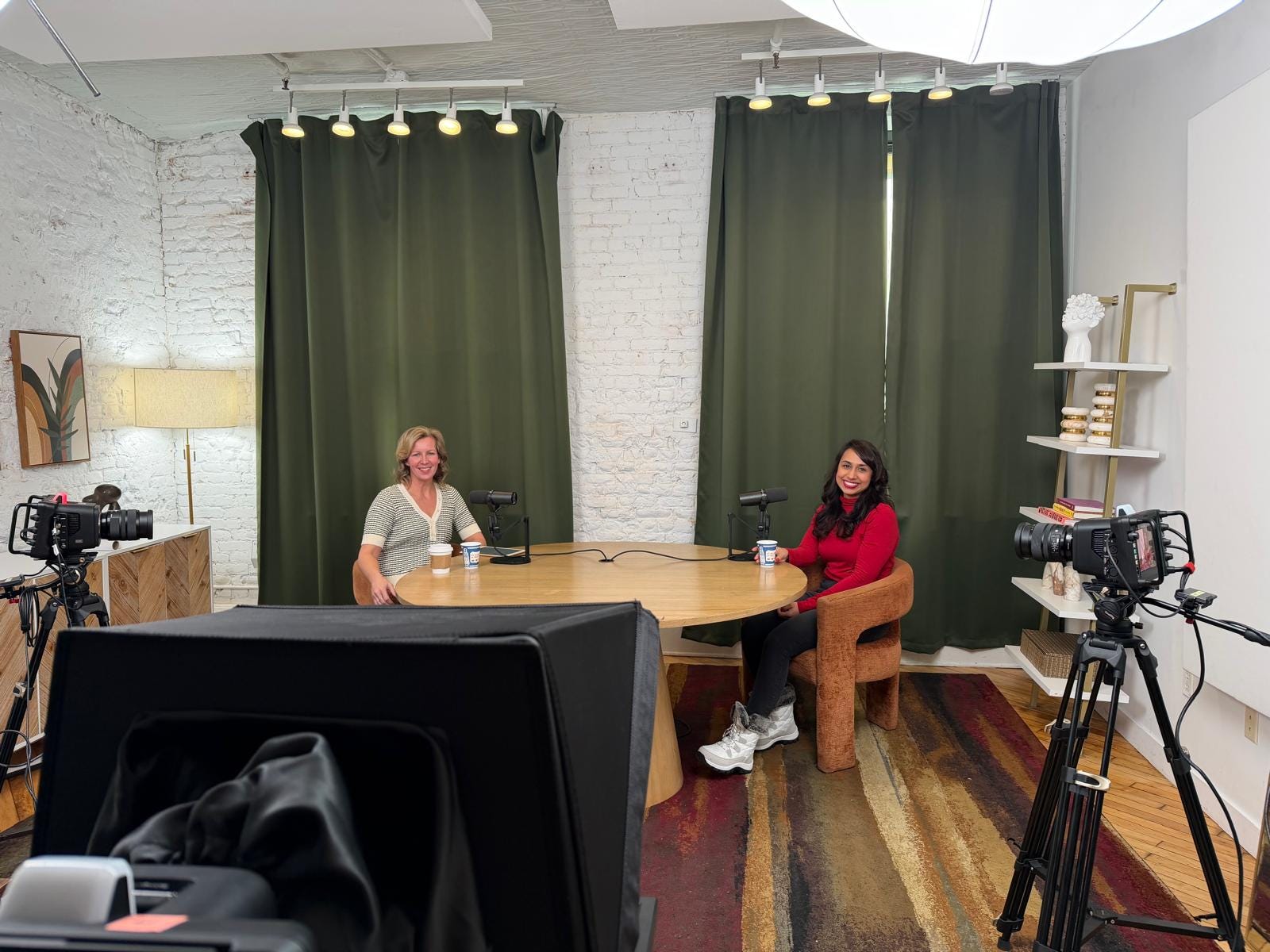
In the latest episode of Between Builds, I sat down with Pam Kaur, a powerhouse in Fintech who operates at the high-stakes intersection of banking, venture capital, and platform leadership. Pam currently leads platform at Alloy Labs and was recently honored by NYC Fintech Women as one of the "Inspiring Fintech Females of 2025."
But as Pam explains, her journey isn't just a collection of impressive titles—it’s a masterclass in the "unlearning" required to lead with conviction. From her upbringing as a child of immigrants where "women should be seen and not heard," to navigating male-dominated boardrooms where she was once told she’d be the "prettiest boss," Pam has had to fight to keep her voice from shrinking. You should definitely tune in and listen, but also take time to read her expanded thoughts on this week’s Between Builds Substack (below).
The In-Between is a Place
Now that I’m several months into my new gig, I’m no longer “between builds” in the literal sense. I’m now building! But, much of my work, and a surprising amount of my growth, happens in the in-between: between ventures and banks, between founders and institutions, between urgency and stewardship.
The seat I occupy every day, and have for pretty much my entire career, holds context that rarely fits cleanly on one side.
Holding the Middle
Sitting between venture, banks, and founders is all about translation. I’m here to hold the context — explaining why something that feels obvious on one side lands as risky, premature, or incomplete on another.
Venture is oriented toward speed, scale, and optionality. Banks are accountable to stability, trust, and regulators who never see upside, only risk. Founders live in between, carrying urgency and belief in equal measure, often before the infrastructure exists to support it.
From the middle, you start to hear where language fractures. “Innovation” becomes “unexamined risk.” “Not yet” is often interpreted as “no.” Momentum outruns governance, and caution gets mislabeled as resistance.
I often see the fracture points before anyone wants to acknowledge them. From this lens, I’ve learned how incentives collide. When you understand how each side is measured, rewarded, and penalized, you can feel misalignment long before it shows up in a contract, a pilot, or a failed partnership.
Translation isn’t neutral work. It carries responsibility.
Once you can see the downstream consequences of a decision: how a shortcut today becomes an exam issue tomorrow, or how a rushed pilot erodes trust that takes years to rebuild, you don’t get to unsee it. You often start holding accountability without authority.
This is the weight of sitting in the middle. The work isn’t visible when it’s demonstrated; it’s visible only when it’s missing. When it works, it looks like nothing happened at all.
The Discipline of Softness
Sitting at the intersection of venture, banks, and founders also means navigating power, often inside legacy systems that were not designed with speed, diversity, or EQ in mind. In that space, softness becomes a discipline.
Authority is rarely granted all at once. It’s tested, negotiated, and often, subtly resisted. In male-heavy rooms, competence is often recognized only when it arrives in familiar packaging. You learn, over time, when decisiveness is respected, when patience is strategic, and when saying nothing at all does more work than explanation.
One of the discomforts I’ve had to sit with is how authority at work sharpens contrast elsewhere. Being clear, directive, and accountable professionally can create an unexpected dissonance when those traits are read differently outside of formal structures. Holding leadership in one context doesn’t automatically translate into being met with the same steadiness in another.
Holding that authority doesn’t mean abandoning softness either, but it does require discernment about where softness is safe. There is a discipline in not hardening, even when being underestimated and relied on at the same time. That duality carries the cost of being trusted with responsibility while having your presence treated as peripheral.
Integrity, in this space, isn’t performative. It’s the choice to remain grounded without becoming rigid while resisting the pressure to prove legitimacy through force.
Power often rewards conformity. Integrity asks for the willingness to stay legible to yourself while operating inside structures that weren’t built for you.
Learning What’s Mine to Hold
There’s a special kind of emotional labor that comes with sitting in the middle. Absorbing urgency, translating disappointment, and carrying a sense of responsibility for outcomes you don’t fully control. For a long time, I treated that weight as part of the job. If something felt heavy, I assumed it was mine to hold and mine to fix.
This season of life has been about learning otherwise.
I’m becoming more intentional about what I carry and what I set down. Discernment is something I’m increasingly learning is part of stewardship. Not every tension needs to be absorbed. Not every misalignment requires my nervous system to resolve it.
This shift in thinking is slowly changing my relationship to responsibility. I still hold strong opinions, informed by pattern recognition, experience, and care, but I’m learning to hold them more loosely and trust that timing will work itself out without me having to force outcomes.
I’m also unlearning perfection as a form of control. Growth, for me now, has become more deliberate. Emotional labor becomes cleaner when boundaries appear. In that clarity, the work feels more honest and aligned with how I want to lead.
Learning to Stay
I don’t have a clean conclusion to offer, but I’ve also come to trust that I’m not always meant to. The work I’m doing, and the work many of us are doing, doesn’t move in straight lines. It unfolds in conversation, restraint, and sometimes through failing and starting over.
Staying here, for me, means staying with the questions. Letting the complexity breathe while resisting the pull toward premature certainty. I am working to choose integrity over urgency, even when speed is rewarded.
I don’t have the answer, but I am paying attention. I’m getting better at holding responsibility without gripping too tightly. I’m learning how to release my opinions back into the world without force. For now, that feels like the most honest place to be.
 | A guest post by
|